What lies behind the “Sign” button: what eIDAS requirements really mean
Article by Justina Dešriūtė, Product Manager at Elpako.
This less visible side of electronic signatures was the focus of my presentation at ESET Security Day 2026, held at LITEXPO on 10 September 2026. This year’s event, themed “Move Smarter. Stay Secure.”, brought cybersecurity professionals together to discuss current security topics and practical challenges.
eIDAS defines qualified trust services, which may only be provided by qualified trust service providers (QTSPs). Achieving this status involves far more than obtaining a certificate or passing a one-off audit. Behind it are technologies, processes, responsibilities and continuous supervision – much of which remains invisible to the user clicking “Sign”.
When choosing an electronic signature solution, businesses should also consider this less visible side of the service. A convenient interface or quick integration is something we notice immediately, but long-term reliability also depends on who provides the individual components of the service, how they are managed and what requirements apply to the service provider.
How does a provider become qualified?
The need to become a qualified trust service provider arises when business processes involve important documents, higher levels of risk and the need to ensure a high level of security and reliability. In such cases, it is no longer enough for a provider simply to state that its service is secure and reliable – compliance has to be assessed independently.
This is where it becomes clear that existing ISO standards or other certifications are not sufficient. A dedicated eIDAS conformity assessment is required, and it can only be carried out by an accredited CAB (Conformity Assessment Body). There are currently no such bodies in Lithuania, Latvia or Estonia, which means auditors have to be engaged from other European countries. The assessment covers much more than the service itself: it includes company documentation and a wide range of internal processes, from employee onboarding and the systems in use to access management and physical infrastructure.
This is also where one important difference between eIDAS and more general security requirements becomes apparent. eIDAS includes detailed technical requirements that define not only how a service must be managed, but also the standards that the software and physical equipment used to provide it must meet. Simply declaring that a system is secure is therefore not enough – security must be reflected in the technical implementation of the service itself.
The journey from the first contact with auditors to obtaining qualified status can take between 6 and 18 months. And the process does not end once the audit has been completed successfully. The audit report is also reviewed by the Communications Regulatory Authority of Lithuania (RRT), which, if no non-compliance is identified, adds the specific service to the list of qualified trust services.
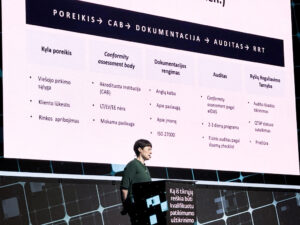
Qualification is a process, not a finish line
“The audit is dead – long live the audit” is quite a fitting description here. A full conformity assessment audit must take place no later than 24 months after the certificate is issued, while a surveillance assessment is typically carried out after around 12 months. In practice, however, monitoring is continuous. Teams change, suppliers change, tools change, security incidents occur – and every such development has to be assessed in the context of eIDAS requirements.
Qualified status is therefore not a diploma that allows the paperwork to be filed away once it has been obtained. More importantly, having QTSP status does not mean that every service offered by the provider automatically becomes qualified. eIDAS covers different categories of qualified services – from electronic signature certificates and timestamps to electronic archiving and other services introduced under eIDAS 2. Each has its own technical requirements and is assessed separately. It is therefore very rare for a single provider to be qualified for every type of service at the same time.
This distinction matters: QTSP status is not a general “trusted provider” label covering everything a company does. Qualification always applies to a specific service. This can be checked in practice through the EU Member States’ Trusted Lists, which show both the provider and the status of each specific qualified service it offers.
One electronic signature – an entire chain of services
To the user, an electronic signature may appear to be a single service. Technically, however, the electronic signing process consists of several interconnected elements: a certificate confirming a person’s identity; a timestamp recording when the signature was created; validation confirming that the signature was valid at the time of signing; and long-term preservation mechanisms that help retain this proof over time. More information about the individual components of electronic signature services is also available from the RRT’s electronic signature information.
A single provider will usually not deliver all of these components itself. Several different providers may participate in the service chain, and companies that compete in one area may become partners in another. Clients do not need to see this entire chain in their everyday use of the service – what matters to them is that the service works reliably. But our responsibility does not end when the “Sign” button is clicked.
It continues through periodic timestamp renewals, archiving strategies and preparation for the possibility that algorithms considered secure today may become vulnerable in the future. A problem with one link in the chain can affect the entire service, which means we must be prepared for both technological and market changes and have alternatives available for individual components.
What does “trust” really mean?
The word Trust in the QTSP acronym may sound abstract, but in practice trust becomes very tangible. It is not simply one relationship between the service provider and the client. There are several relationships involved, and each of them matters in its own way to the electronic signature infrastructure as a whole.
First, there is trust between the individual and the service provider. Users need to know that their electronic signature will work when they need it and that its legal validity and reliability will not be called into question. Even a minor technical issue experienced by the user can undermine confidence in the entire service, because an error appearing in our system will naturally be perceived as the provider’s problem. In an RRT survey, respondents also identified a lack of information about electronic signatures as one of the barriers to using them.
Another relationship exists between the service provider and the RRT. This communication is not limited to the certification process. The RRT provides information about changes to the infrastructure, clients may contact the authority regarding how a service operates, and the authority itself may alert a provider to problems observed in a client’s system. There is therefore an ongoing exchange of information between the supervisory authority, service providers and clients.
Trust between other QTSPs operating in the market is equally important. Qualified European providers are included in national Trusted Lists, while the European Commission publishes the LOTL (List of Trusted Lists), which brings together the national trusted lists. In Lithuania’s list, Elpako is listed under UAB NEVDA, the company that provides the Elpako service. If the status of one provider involved in our service chain changes, or if that provider ceases operations, other participants in the same chain may be affected directly.
Finally, there are the third parties involved in the supply chain – cloud service providers, data centres, network infrastructure providers and suppliers of physical equipment. Outsourcing part of the service does not mean outsourcing our responsibility along with it. Even when third parties are involved, we still need to assess their risks, monitor them and define specific security obligations in our contracts.
All of these relationships are connected by one principle: trust is not a one-off achievement granted together with a certificate.
A QTSP is more than a technology provider
Another side of QTSP work becomes visible when a client’s needs go beyond technology alone. For example, a client may have a company branch in Latvia and want to use QSeal so that documents can be signed on behalf of the company there in the same way as in Lithuania. In such a case, providing a technically functioning service is not enough. We also need to understand Latvia’s regulatory infrastructure, work with a provider operating there and ensure that the entire service chain on both sides meets QTSP requirements.
At that point, the work becomes much more than an IT project. In practice, QTSPs also have to deal with questions of business logic, legal requirements and organisational processes, particularly when a service needs to operate across several countries and different regulatory environments.
These requirements also extend into our own organisation. Employee selection becomes more stringent, training is required before access to systems is granted, we need to continuously ensure that only authorised individuals can access certain parts of the infrastructure, and working system backups must be maintained. Ultimately, a QTSP must be able to demonstrate at any time that people, processes and technology together form a reliable system that operates 24/7.
We take eIDAS seriously
Most of this work will never be visible to the person clicking “Sign”. Behind that action are audits, technical requirements, supplier management, supervisory authorities, internal processes and continuous responsibility for the entire service chain.
That is why eIDAS requirements play an important role in how we build and develop Elpako. They influence not only technical decisions, but also our processes, our choice of partners and the time required to develop the service. Qualified status is not a one-time milestone in the product development journey. It requires continuous compliance monitoring and the ability to adapt as technology, markets and regulation evolve.
For the user, however, all of this ultimately needs to come down to one simple action – “Sign”.
If you are considering how an electronic signing solution could work within your organisation’s processes, feel free to contact me. We can discuss your situation, the requirements imposed by eIDAS and how we address them at Elpako.
Justina Dešriūtė, Product Manager at Elpako
[email protected]
GITEX Europe 2026: As AI Becomes Business as Usual, Trust Becomes a Competitive Edge
Several themes that emerged at GITEX Europe 2026 echoed what the Elpako team had already observed at Identity Week Europe 2026. Digital identity is becoming a core part of modern infrastructure, qualified electronic signatures need to work seamlessly across countries and systems, and organisations are no longer satisfied with isolated technology components.
GITEX, however, approached these topics from a more practical angle. The focus was less on what the digital future should look like and more on where technology is already changing how organisations operate today, from document analysis and cyber threat management to identity assurance, data sovereignty and the trust services market.
“GITEX made one thing particularly clear to me: AI is no longer a standalone innovation topic. It is becoming an operational layer that quietly supports everyday processes such as analysis, verification, document preparation and decision-making,” says Rokas Jašinskas, Business Development Manager at Elpako.
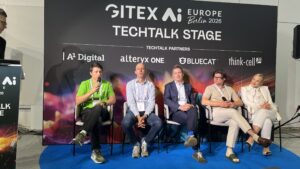 Rokas Jašinskas joined a discussion on the TechTalk Stage at GITEX Europe 2026 in Berlin,
sharing his perspective on AI, digital trust and the practical use of technology in organisational processes.
AI creates value when applied to a specific process
One of the clearest developments at GITEX Europe 2026 was the growing maturity of AI adoption. Organisations are spending less time discussing broad AI strategies and more time identifying specific, measurable use cases.
This shift was especially visible in document and knowledge management. Solutions presented at the event demonstrated how AI can simplify the preparation and analysis of complex legal and administrative documents.
“This is highly relevant to us in practical terms. Document drafting, contract analysis and the preparation of public procurement responses are areas where AI does not need to replace people. It can help them structure information faster and make better-informed decisions,” says Jašinskas.
AI delivers real value when it reduces repetitive manual work and accelerates tasks that previously required multiple rounds of reading, checking and approval.

AI is becoming a defensive cybersecurity tool
One of the most interesting cybersecurity themes at GITEX Europe 2026 was not the fact that AI can be used to launch cyberattacks. That is already well understood. The more important development is that organisations are increasingly using AI to defend themselves through threat detection, alert prioritisation, incident investigation and faster response.
Security teams deal with vast volumes of signals, alerts and potential incidents every day. AI-powered solutions showcased at GITEX demonstrated how teams can identify the most important threats more quickly, organise information and shorten the path from an initial warning to an informed response.
“What mattered most to me was not the technological spectacle, but its practical role. AI can help security teams understand what is actually happening sooner and prevent a developing problem from turning into an incident that is much harder to contain,” says Justina Dešriūtė, Head of Product at Elpako.
The session “The CISO Crisis: Liability, Burnout & the New European Risk Landscape” also placed strong emphasis on the changing role of security leaders. As regulatory pressure, technological complexity and personal accountability for incidents increase, the CISO can no longer be treated as a purely technical position.
“Security has not been merely an IT issue for a long time. It directly affects reputation, compliance, business continuity and executive decision-making. If someone is accountable for risk, they also need a genuine role in the decisions that shape that risk,” says Dešriūtė.
Another important takeaway was that the most dangerous fraud increasingly does not look suspicious. Instead, it imitates normal user behaviour. Trust can therefore no longer be assessed solely on the basis of a document or login. Organisations need to consider the wider context, including the device, environment, behaviour and risk level of the process.
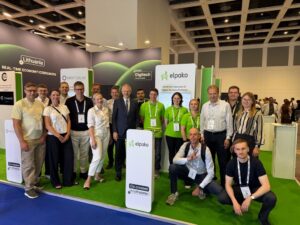 Representatives of Lithuanian technology companies at GITEX Europe 2026 in Berlin,
at the joint Lithuanian pavilion organised by INFOBALT.
Demand for electronic signatures remains strong, and an API alone is no longer enough
One notable observation from GITEX Europe 2026 was that, despite the abundance of AI, cybersecurity and automation solutions, relatively few exhibitors specialised in digital signatures or qualified trust services. Conversations with organisations, however, showed that demand in this area remains strong.
“This was one of the more interesting signals for me. AI, security and automation dominated the event, while digital signature and qualified trust service providers were less visible. Yet as soon as you start speaking with organisations, it becomes clear that the need has not disappeared,” says Egidija Bieliauskienė, Head of Sales and Business Development at Elpako.
European customers are increasingly looking for alternatives to the large US-based signing platforms. They are interested not only in a convenient signing experience, but also in solutions designed around European regulatory requirements.
“Customers no longer want just a ‘Sign’ button. They ask how identity is verified, whether the signature is qualified, whether a complete audit trail is available, how the solution fits into their existing processes and whether it meets regulatory requirements,” says Bieliauskienė.
This means that a signing API alone is often no longer sufficient. Customers expect a broader solution that supports the entire document lifecycle, from collecting data and preparing the document to signing, storage, validation and audit.
Cross-border signing also remains a major concern. Although qualified electronic signatures have a clear legal basis throughout the European Union, signing between different countries is still not as simple in practice as organisations expect.
“The European market needs a straightforward way to use qualified electronic signatures across borders. The legal framework is already there, but the user experience and practical implementation still create friction. Elpako sees this as a natural direction for further development,” says Bieliauskienė.
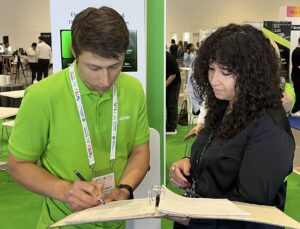 Rokas signs by hand at the organiser’s request.
For the Elpako team, this has almost become an unusual experience.
Germany offers major opportunities but expects high standards
Germany remains one of the most attractive markets for digitalisation solutions. Many public-sector processes still depend on paper documents, manual approvals and fragmented systems. Solutions capable of reducing a process from several weeks to a matter of minutes therefore offer clear and immediate value.
At the same time, the German market sets a high bar. Functionality alone is not enough. Localisation, data residency, GDPR compliance, national security considerations and long-term confidence in the provider all play an important role.
“When you live in Germany, you quickly realise that strong functionality alone will not win the public sector. Organisations want to know where their data is stored, how it is processed, whether the solution reflects the local regulatory environment and whether the provider can be trusted over the long term,” says Dešriūtė.
Data sovereignty is becoming a genuine purchasing criterion rather than an additional technical benefit. For Elpako and NEVDA, this creates a clear direction: product development must take account not only of features, but also of country-specific deployments, local hosting options, European infrastructure and regulatory requirements.
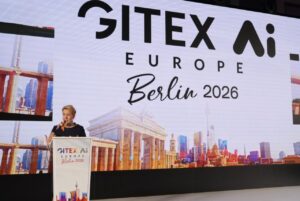
The trust services market is maturing
GITEX Europe 2026 also highlighted a broader shift in the trust services market. Europe’s qualified trust services sector is maturing and beginning to consolidate. Larger providers are strengthening their positions, certification requirements are becoming more demanding and barriers to market entry are increasing.
“As a market matures, there is less room for isolated or improvised solutions. Customers need providers that understand regulation, have proven experience and can deliver more than a single feature. They need reliable infrastructure for digital processes,” says Bieliauskienė.
In the coming years, this market will be shaped even more strongly by eIDAS 2.0, NIS2 and the growing focus on the security of critical infrastructure, digital identity and trust services.
“Our ambition is for Elpako to be more than a signing tool. The market is moving towards broader solutions that bring identity verification, signing, compliance, process automation and integrations together,” Bieliauskienė adds.

Raising the profile of Lithuanian technology in Europe
GITEX Europe 2026 was valuable not only for the technology insights it offered, but also for the relationships it helped create. INFOBALT played an important role in strengthening the visibility of Lithuanian technology companies and supporting international connections.
Elpako also attended a networking event organised by the Embassy of Lithuania in Germany. It provided an opportunity to speak directly with German organisations and gain a more detailed understanding of their digitalisation needs.
“Events like these are not valuable only because of the contacts you make. Direct conversations with German organisations help you understand where digitalisation is genuinely getting stuck and what kinds of solutions the market is actually looking for,” says Jašinskas.
While Identity Week Europe 2026 placed particular emphasis on digital identity, wallets and interoperability, GITEX Europe 2026 revealed another side of the same transformation. It showed how AI, cybersecurity, document processes and data sovereignty are already reshaping the everyday work of organisations.
“GITEX confirmed that the direction for Elpako and NEVDA should not be a collection of separate features. We need to strengthen the complete document process, from document preparation and identity verification to qualified signing, storage, auditing and integration with other systems,” Jašinskas concludes.
This is where Elpako sees its future: building solutions in which signing is not an isolated action, but an integral part of a secure, trusted and fully auditable document process.
Insights from Identity Week Europe 2026: Why Technology Is No Longer the Biggest Digital Identity Challenge
For the Elpako team, the event highlighted several key trends that could significantly reshape digital services, customer interactions, and business processes across Europe in the coming years.
Digital Wallets Are Moving from Concept to Infrastructure
The European Digital Identity Wallet (EUDI Wallet) was one of the most discussed topics throughout the conference, both on stage and across the exhibition floor. More organisations are positioning themselves as “wallet-ready,” while pilot projects are already underway in several European countries.
This momentum is being driven by the updated eIDAS 2.0 Regulation, which aims to establish a unified digital identity framework across Europe. The regulation introduces digital wallets that will enable citizens and organisations to securely use and share verified information across borders and between service providers.
However, one message was repeated throughout the event: the biggest challenge is no longer the technology itself.
“Everyone talks about a single European standard, but in reality, we still need to align numerous national systems, legal requirements, and identification methods,” says Egidija Bieliauskienė, Head of Sales and Business Development.
Discussions also emphasised that the EUDI Wallet should not be viewed as just another authentication method or a digital document folder. According to Elpako Product Manager Justina Dešriūtė, it represents a fundamental shift in how organisations exchange information.
Digital wallets will serve as secure repositories of trusted data. They will be able to store everything from identity credentials and driving licences to company representation rights, licences, and other officially verified information.
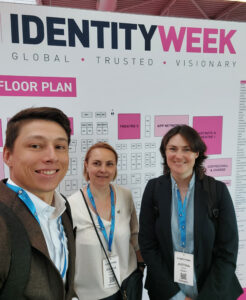
The Elpako team at Identity Week Europe 2026 in Amsterdam.
From left to right: Rokas Jašinskas, Egidija Bieliauskienė, and Justina Dešriūtė.
More importantly, they introduce a new model for information exchange. Until now, organisations have largely relied on sharing documents that must be repeatedly submitted across different systems and processes. The wallet model replaces this with reusable, verified, and trusted data.
In practice, this means organisations will no longer need to repeatedly request the same certificates or supporting documents. Verified information can be shared securely and directly between systems whenever needed.
For end users, the technical complexity behind these processes will be largely invisible. What matters is that services are fast, seamless, and consistent. Achieving this will require more than technology alone—it will depend on regulatory alignment, political cooperation, and organisations’ willingness to adapt their existing processes.
Europe’s readiness for digital wallets remains uneven. Countries such as Denmark are already launching operational solutions and moving into real-world adoption, while others remain in planning or early pilot stages. This demonstrates that building the technology is only part of the challenge; market readiness and institutional adoption are equally important.
Electronic Signatures Are Becoming Simpler and More Accessible
One of the main conference sessions focused on the future of qualified electronic signatures within the digital wallet ecosystem.
Speakers noted that electronic signature adoption has often been slowed by fragmented technologies, integration challenges, and national differences. Common standards and EUDI Wallet infrastructure have the potential to significantly reduce these barriers.
As a result, qualified electronic signatures are evolving from standalone services into a natural component of digital identity infrastructure. Standardisation and interoperability will make them easier, faster, and more widely accessible across Europe.
Business Wallets May Arrive Faster Than Consumer Wallets
Although public discussions often focus on wallets for citizens, one of the most interesting insights from the event was that business-oriented wallets may reach the market sooner.
Business wallets could contain company registration information, representation rights, licences, ownership structures, and other verified organisational data. This would enable instant partner verification, supplier assessments, and cross-border business transactions.
According to Justina Dešriūtė, the real value of business wallets lies in an organisation’s ability to quickly and reliably prove facts about itself.
Even more importantly, they enable a shift away from repeatedly submitting the same documents. Instead, organisations will be able to share verified information directly from their wallets whenever required.
This approach not only accelerates business processes but also reduces administrative effort and the risk of errors.

Financial Services See the Greatest Potential
The financial sector was repeatedly highlighted as one of the first industries likely to benefit from digital wallets at scale.
Today, opening a business account or completing Know Your Customer (KYC) procedures can still take hours, days, or even longer. Organisations often need to collect numerous documents, perform manual checks, and repeatedly verify the same information.
“The financial sector clearly demonstrates the potential of digital wallets. Processes that currently take days or weeks could eventually be completed almost instantly,” says Rokas Jašinskas, Business Development Manager.
Digital wallets allow organisations to obtain verified information directly from trusted sources, making processes faster, more accurate, and less dependent on manual work.
The Real Challenge Is Adoption, Not Technology
A recurring theme throughout the conference was that even a fully functioning infrastructure is not enough. The real challenge begins when people and organisations need to adopt it in their everyday activities.
For digital wallets to become mainstream, users must trust them, organisations must be ready to accept them, and clear use cases must demonstrate tangible value.
Inclusion was another important topic. Several discussions stressed that digital identity solutions should coexist with alternative service channels for people who cannot or choose not to use digital tools.
At the same time, even well-designed and secure solutions will only succeed within a broader ecosystem. User trust and organisational readiness are essential, but so is the ability of systems, service providers, and countries to work together seamlessly.
This leads to another challenge that surfaced repeatedly throughout the event: fragmentation.

Fragmentation: The Hidden Cost of Digitalisation
One reason even advanced digital identity solutions struggle to achieve widespread adoption is the fragmented nature of today’s ecosystem. Users care less about how many technologies exist and more about whether those technologies work together.
Walking through the exhibition floor, it became clear that the market is not lacking technology. Solutions ranged from digital wallets and electronic identification platforms to biometric verification, electronic signatures, fraud prevention tools, and identity management systems. Nearly every problem already has multiple solutions.
The greater challenge lies in connecting these technologies into a seamless service experience.
Different standards, disconnected systems, and inconsistent processes have become major barriers to effective digitalisation. Fragmentation often results in higher costs, longer processes, and poorer user experiences.
As Rokas Jašinskas points out, the market offers plenty of individual components and technologies, but far less attention is given to connecting them into a unified customer journey.
What Did Identity Week Europe 2026 Confirm?
If the event’s main message could be summarised in a single sentence, it would be this:
Europe does not lack digital identity technologies. The challenge now is bringing them together into a seamless user experience.
The biggest obstacles today are user trust, organisational readiness, interoperability between systems, and the ability to deliver smooth and consistent experiences.
For the Elpako team, the event reinforced a belief we have held for some time: future competitive advantage will belong not to those who create yet another technology component, but to those who can combine multiple technologies into invisible infrastructure that enables people to access services faster, more simply, and more securely.
This is the direction increasingly visible across Europe today—and it may become the defining factor in the next stage of digital identity evolution.
Virtual Printer – Elpako New Feature for Fast Document Signing
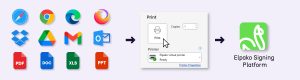
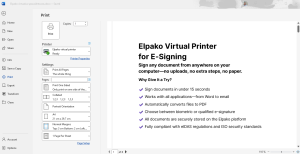
Signing documents directly from the print window isn’t new—but Elpako took a fresh approach and made it faster and even more intuitive. With the Virtual Printer, the process is as straightforward as:
Open → “Print” → Sign.
No pop-ups, no redundant steps—just a smooth, self-explanatory workflow. Fewer clicks. More efficiency.
Key Benefits
Simplicity
- Send your document directly to Elpako signing platform straight from the print window—no need to download, open your browser, or manually upload anything.
- The entire process takes less than 15 seconds.
Versatility
- Compatible with any application: Word, Excel, PDF, PowerPoint, JPG, PNG, browsers (Chrome, Edge, Firefox), documents from Google Drive, and emails from Outlook or Gmail.
- Automatically converts any file type into a PDF for signing.
Freedom of Choice
- Choose between a biometric or a qualified e-signature. You can sign the document yourself or invite someone else to sign.
- You see the document instantly and place your signature exactly where it needs to go—with a simple click or drag of your mouse.
Centralized Management
- All signed documents are securely stored on Elpako platform, with convenient tools for search, viewing, analysis, and exporting.
- You can track who has signed and easily resend the document for signing if needed.
Security
- All signatures meet eIDAS and ISO security standards, ensuring full legal validity.
- Because the document remains digital and never leaves the secure environment, risks like data leaks or printing errors are minimized.
When to Use the Virtual Printer vs. the Platform
The Virtual Printer is ideal when the document is already prepared and doesn’t require any additional information to be filled in—such as when an HR department sends a confidentiality agreement to a new employee for signature.
The platform is best suited for cases where the document needs to be both filled out and signed—for example, when a patient at a medical facility must provide details about their health condition and sign a consent form before a procedure.
How It Works – Step by Step
-
Install the Elpako Virtual Printer tool on your computer.
-
Open the print window in any program and select “Elpako Virtual Printer” from the printer list.
-
Log in to your Elpako biometric signing account (only needed the first time).
-
Choose your signature type: biometric or qualified e-signature.
-
Sign the document—it will be instantly saved on the Elpako platform.
Biometric vs. Qualified E-Signature – What’s the Difference?
Both signature types are legally valid, but they’re suited for different contexts—in-person or remote.
-
Biometric Signature
Best for in-person signing, such as at a customer service desk.
Signed using a tablet and digital pen, capturing unique traits like pressure, speed, and movement. -
Qualified E-Signature
Ideal for remote signing.
Uses Smart-ID, Mobile ID, or a national ID card. Legally equivalent to a handwritten signature.
Try It Today
The Virtual Printer is now available to all Elpako Biometric Signature users.
Try it out and experience a faster, simpler way to sign documents—right from your desktop.
Med.I.S. and Elpako Integration – More Capabilities in a Single Solution
Digitization has long moved beyond basic administrative tasks. Today’s biggest challenge is ensuring that every step – from patient registration to signing medical documents – happens quickly, securely, and without the need for paper.
This is where the integration of Med.I.S. and Elpako comes in. Imagine a workflow where signing documents is not a separate task but a natural part of your daily routine – done right on a tablet during patient interaction. It’s not just convenient – it’s a major step toward fully digital healthcare.
Med.I.S. – Driving Efficiency in Your Facility
Med.I.S. is a unified information system that connects every part of your healthcare facility. It’s more than just software – it’s a solution built on years of real-world medical experience, trusted by around 40 healthcare providers across Lithuania.
Designed to adapt to any organization – whether you have five or five hundred employees – Med.I.S. helps streamline and elevate your operations.

Key Benefits:
Operational Efficiency:
- Standardizes and automates internal workflows, reducing human error and saving valuable staff time.
- Supports better resource management and lets you focus on what matters most – patient care.
- Reduces administrative costs and boosts overall institutional performance.
Seamless Coordination and Usability:
- Aligns all departments for smooth collaboration and efficient information flow.
- Operates in real time – giving you access to the most current data.
- Modular structure easily adapted to your specific institutional needs.
- Ergonomic and intuitive – easy to learn and use in everyday work.
Legal Compliance:
- Constantly updated to reflect the latest legal requirements.
- Integrated with the National Health Insurance Fund system “SVEIDRA” and its subsystems (SPAP, PRAP, APAP) – automating data exchange and reducing manual tasks.
Elpako – A Signature That Simplifies, Not Complicates
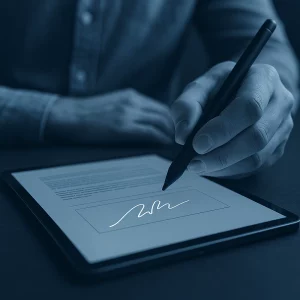
Signing documents shouldn’t stand in the way of digital progress. With Elpako’s biometric signature integrated into Med.I.S., you can sign documents directly on a tablet – quickly, smoothly, and legally. Forget printing, scanning, and archiving.
Top Benefits:
Flexibility:
- Choose between biometric and qualified electronic signatures depending on the context.
- Suitable for both staff and patient signatures – providing convenience across all areas of operation.
Speed and Convenience:
- Signing takes only seconds – no delays or extra steps.
- Templates make it easy to create recurring documents, reducing administrative burden.
- Assisted mode lets the staff and patient view the same document on separate screens – the patient on a tablet, the physician on a computer.
Security and Legal Validity:
- Captures unique biometric data – stylus pressure, movement, and signing speed – ensuring authenticity and protection against forgery.
- Complies with the eIDAS regulation – the EU-wide legal standard for electronic signatures.
- Signature data is encrypted and securely stored at the time of signing – preserving integrity and preventing tampering.
Digital Maturity – When the Signature Becomes Part of the Process
Digitization in healthcare shouldn’t stop at document signing. With Elpako integrated into Med.I.S., signing becomes part of the real work – done on the tablet, alongside the patient.
It’s not an extra step – it’s a seamless, modern, and trusted solution that works naturally for everyone involved.
Want to See It in Action?
Contact us today!
www.elpako.lt | [email protected] | +370 620 54 160
Don’t let paper and slow processes hold your facility back.
Choose a digital solution that works.
GITEX Europe 2025. The Future Inspires, but Real Solutions Address Today’s Challenges
After the exhibition, Justina shared insights into Europe’s digitalization landscape. In May 2025, Germany launched its first Ministry for Digitalization and State Modernization, aiming to centralize and strengthen digital processes. However, as the Elpako team notes, bringing this vision to life still faces major obstacles.
Due to Germany’s federal structure, digital progress varies widely across institutions. Some public agencies are implementing advanced solutions, while many still rely on outdated methods for document management. An estimated 80–90% of documents are still sent by fax. Meanwhile, the country’s waste management sector is among the most advanced, using smart cameras and AI to analyze recycling quality.
“This contrast clearly shows that digitalization is uneven. While some sectors use advanced technologies, fundamental processes—like document handling—are still being neglected,” explains Justina.
In this context, Elpako believes the true value lies not in showcasing the latest technologies, but by applying them where they truly solve user problems. The electronic signature stands out as a key element in digital transformation, enabling smooth, secure, and legally sound processes across both public and private sectors.
“Our goal is to deliver solutions that impact everyday life—not with futuristic ideas, but with concrete results. Signing should be fast, intuitive, and reliable,” emphasizes Elpako Product Director.
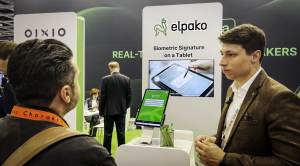
Technology Inspires – but It’s Valuable Where It Works Today
At GITEX Europe, high-tech innovations took center stage. These included breakthroughs in quantum computing and the latest in financial technologies. One standout was the IBM Quantum System Two, a next-gen quantum system marking a leap forward in AI and supercomputing.
Elsewhere at the exhibition, lively discussions revolved around digital wallets and identity verification. The fintech sector introduced not only technical solutions but also fresh perspectives on making digital payments more trustworthy, faster, and user-friendly. Many participants stressed the growing interest in seamless identity recognition, using biometric data or digital ID wallets. This shift reflects not just technological progress, but also a new approach to building trust.
Amid the innovation, serious warnings also emerged. Artificial intelligence was a key topic, not just in displays but in discussions. Cybersecurity behavior analyst Mark T. Hofmann gave a compelling talk on the ‘dark side of AI’, revealing how criminals exploit generative models like ChatGPT, WormGPT, and deepfakes through techniques like prompt engineering and jailbreaking. His message was clear: the more powerful the technology, the greater the responsibility in how it’s used.
“Innovation should stay grounded in reality. Tech developers must consider not just what’s possible, but how it impacts people’s everyday experiences,” notes Justina.
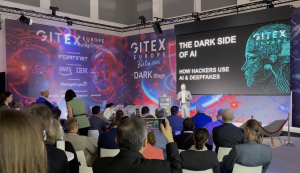
Elpako’s Vision: Solving Where It Hurts Most
The Elpako biometric signature platform isn’t just for show; it’s built for real-world use. It allows users to quickly and securely sign documents on a tablet, use templates, work in assisted mode, and integrate seamlessly via API into existing systems. Fully compliant with the eIDAS regulation, the platform is suitable for both public and private sectors.
“When the process works, it saves time, prevents errors, and strengthens trust between clients and organizations. That’s what true digitalization should deliver,” Justina emphasizes.
Purposeful Partnerships for Thoughtful Growth
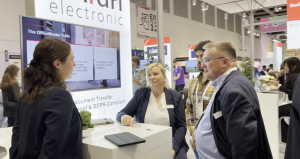
During the event, Elpako met with Ferrari Electronic AG. This company builds secure and efficient communication systems. With experience across public and private sectors, Ferrari Electronic helps develop digital solutions that meet high legal standards and user expectations.
“Collaborating with partners like this allows us not only to build a product but also to contribute to broader digital transformation efforts. It’s not just about growth—it’s about responsibility,” Justina shares.
The future may inspire us, but the solutions that truly transform experiences are rooted in a deep understanding of how things work today. Elpako embraces that vision, developing technology that serves people, not the other way around.
When Business Moves Faster Than Its Paperwork
These scenarios are common—not because people don’t want to work efficiently, but because the tools they have can’t keep up. A mechanic inspects a vehicle with the client, yet still has to fill out paperwork at the front desk. Logistics specialists carry folders around the warehouse because they don’t have time to get back to a computer. Real estate agents return to the office just to send out documents via email. All these disruptions slow down workflows, increase the chance of errors, and ultimately hold businesses back.
What Does True Business Mobility Look Like?
Today, business must go where the customer is—mobile, agile, and fast. But true mobility requires more than a laptop or a smart device. It demands a shift in mindset: a continuous flow of information and decisions made in real time, on-site. Traditional document management—offices, paperwork, printers, disconnected systems—creates friction where there should be flow.
Digital mobility isn’t just about convenience. It represents a change in business culture: less formality, more trust between employee and customer; less waiting, more engagement. It fosters not only productivity but a better emotional work environment—where processes help rather than hinder. That’s exactly what Elpako Biometric Signature Platform enables: seamless, secure, and legally valid work—without interruption.

What Does Real Mobility Look Like?
Elpako solution is more than just an electronic signature. It’s a complete approach to document management—done through a single device, in one system, without extra steps:
-
Pre-built templates – no need to create documents on the spot.
-
On-site form completion and biometric signing – right where the job happens.
-
Instant document delivery – to clients or colleagues, with automatic syncing to your company’s document management system.

Four Real-World Scenarios from Everyday Business
Auto Repair Shop
A mechanic discusses necessary repairs with the client on-site. The details are immediately recorded in a digital form, photos of the vehicle are attached, and everything is signed using a tablet with a biometric signature. The form is then emailed to the client. No extra paperwork, no administrative burden. The client gets full transparency and documented proof—saving time and avoiding any confusion.
Field Service Teams
A technician responds to a burst pipe at a client’s home. He records the work done, adds photos, signs the document on a tablet, and the form is instantly sent to both the client and the office. No printing, no phone calls. The client gets immediate confirmation, and the company gets an accurate record.
Equipment Rental
A technician delivers construction equipment to a job site. The handover form is completed on a tablet, equipment condition is recorded, photos attached, and both parties sign biometrically. The document goes straight to the office. All the information is stored where it’s needed and ready when it’s needed—essential when equipment moves between multiple sites daily.
Insurance Claims
An insurance assessor visits a client’s home after an incident. They document the damage, complete necessary forms, add photos, sign the report on a tablet, and send it straight into the insurer’s system. The client doesn’t need to visit an office, and the claims process begins within minutes—easing stress and accelerating service.

Why This Matters for You
Maybe your company’s processes are technically “under control”—but how much time does it really take? Filling out paper documents on-site, transferring and sending them, making phone calls to confirm details—these steps cost work hours. Employees often revisit clients just to “finalize” a process, leaving customers uncertain about the outcome.
Smooth document management isn’t a bonus—it’s a foundation. When the system runs without friction, clients feel confident and employees feel in control. This isn’t just about saving time. It’s about peace of mind, speed, and respect for everyone’s time.
Businesses that adopt mobile signing solutions often see a 15–30% increase in services completed during a single visit. That means not only happier customers, but real financial results—fewer return visits, less wasted time, and more revenue per working hour.
If your team still waits to “handle documents” at a computer, it means one thing—you’re losing efficiency every single day.
Mobility Principles That Transform Customer Service
-
Speed: Less waiting, more doing.
-
Accuracy: Data is captured immediately—reducing the risk of forgetting or mixing things up later.
-
Trust: Clients are involved in the process and understand every step.
-
Efficiency: One visit = task completed.

Mobility isn’t the future—it’s the present, and the fast are already winning.
While some are still figuring out schedules and paperwork logistics, others are completing entire workflows on the spot, in just minutes. Some wait—others act. Every delayed step is a lost opportunity to deliver at the right time.
Digitization isn’t just a tech upgrade. It’s a way to free up time, reduce stress, and let your team focus on what they do best—serving clients, not managing paperwork. When documentation becomes invisible, business becomes faster, clearer, and more pleasant for everyone involved.
The less someone feels like they’re “handling documents,” the more efficient your organization becomes. Not because documents aren’t important—but because they no longer get in the way. When information flows seamlessly, your business moves decisively and quickly.
Start working faster, simpler, and smarter—with the Elpako Biometric Signature Platform.
To learn more, contact Business Development Manager Rokas Jašinskas at +370 620 54 160 or email [email protected].