From the repair shop to the warehouse: how ECount and Elpako are changing document signing
These extra steps can be avoided. ECount, the business accounting system developed by Insolita, now offers more ways to sign documents electronically. Alongside Elpako’s qualified electronic signature, which was already integrated into the system, users can now choose biometric signing. This allows customers to sign documents directly on a tablet using a digital pen.
“One of our clients repairs around 2,000 cars a month. Lithuanian regulations require car repair orders to be recorded on forms that customers must sign and the business must then retain. When thousands of these documents build up, printing and managing them becomes a considerable administrative burden. Seeing how much extra work this creates, we wanted to find a way to make the process easier,” says Vytenis Dulskis, Director of Insolita.
Electronic signatures in business: different documents, different needs
ECount is a modular business and accounting system for managing purchases, sales, orders, stock levels and other daily business processes. According to its developers, around 95% of Insolita’s clients operate in the car and motorcycle sector, mainly as repair shops and car parts wholesalers.
These businesses sign a wide range of documents every day, from repair orders to agreements with business partners and confirmations that goods have been handed over. A qualified electronic signature suits some processes, while signing on a tablet with a biometric signature is more convenient for others.
Some of these features are already used in ECount. Other examples below show how biometric signing could support additional business processes.
Car repair shops: signing a repair order form on a tablet
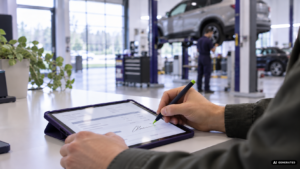
A customer arrives at a repair shop and leaves their car for repairs. An employee prepares a repair order form in ECount, including the vehicle details, planned repairs and other relevant information.
With a paper-based process, the employee has to print the documents, prepare copies and arrange for them to be stored. With Elpako, the completed form is sent to a tablet as a PDF. The customer can review it and add a biometric signature using a digital pen.
The form can therefore be signed while the customer is still at the repair shop, without the employee having to prepare separate paper documents.
Car parts sales: from agreements to product returns
Car parts businesses handle customer and supplier orders, sales, returns and payments every day. ECount helps manage these processes, and some of the related documents also need a signature.
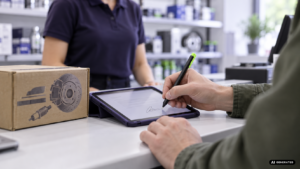
For example, agreements with business partners can be signed using a qualified electronic signature. Biometric signing could be used in other situations, such as when a customer returns car parts. The employee accepting the goods could display the return document on a tablet and ask the customer to sign to confirm the handover.
According to Insolita Director Vytenis Dulskis, a larger car parts wholesaler records around 10,000 sales transactions a month. Although not every transaction requires a signature, businesses working at this scale need to make the related paperwork as simple as possible.
Warehousing and logistics: confirming delivery
Warehousing and logistics involve more than picking an order. Businesses also need to make sure the goods reach the recipient. ECount allows users to manage stock levels, plan order picking in the warehouse, arrange deliveries using their own vehicles and track shipment status.
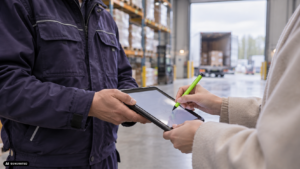
For example, a driver delivers an order to a customer. The recipient checks the goods, and the handover may also need to be recorded. With biometric signing in place, the recipient could review the delivery document on a tablet and sign it on the spot.
This could add a clear confirmation of receipt to the delivery process and make it easier to link each delivery to its supporting document.
What has been added to the ECount and Elpako integration?
Electronic signing is already available in ECount. Through Elpako, users could previously sign internal documents with a qualified electronic signature and send invitations to sign agreements.
The latest update adds biometric signing. This is particularly convenient when a customer needs to sign a document in person at the point of service.
At first glance, biometric signing looks like signing on paper. However, signing on a tablet captures more than the image of the signature. It also records biometric data, such as pen pressure, movement speed and angle. This information may be relevant when assessing whether a signature is authentic.
The integrated solution allows users to send a PDF from ECount to a tablet or another compatible device for signing. The signed document can be kept in Elpako’s document storage or downloaded and saved elsewhere.
More document signing options on the Elpako platform
ECount users who need more signing options can use the same account to access Elpako’s biometric signing platform. It offers additional features:
- Document templates. Frequently used documents can be prepared in advance, with fields for entering information and adding signatures.
- Assistance mode. The employee and customer see the same document on separate screens, allowing the employee to help the customer complete it.
- Standby mode. The tablet can display the company logo or another chosen image while waiting for a document to be signed.
- Drawing fields. Users can add markings by hand, such as indicating damage on a vehicle diagram.
- Virtual printer. Documents from other applications can be sent directly to Elpako’s signing platform.
The platform also allows users to send document templates for customers to complete and sign on their own, track document status, use automatic reminders and store signed documents.
How does electronic signing help businesses?
One of the main benefits is less administrative work. When documents are prepared and signed electronically, employees can spend more time on their main tasks and less time preparing and managing paperwork.
Documents stored digitally are also easier to find and review when needed. This is particularly useful for businesses that handle large volumes of documents every day and need to keep them traceable.
Customers benefit too. When they visit in person, they can review and sign a document on the spot. For remote signing, a qualified electronic signature can be used. This allows businesses to choose a signing method that suits each situation, without requiring every customer to follow the same steps.
Electronic signing can become part of your business system too
ECount is one example of how Elpako’s electronic signature solutions can be integrated into business systems that companies already use.
With the Elpako API, software developers can add electronic signing to their systems. Depending on their needs, this can include qualified electronic signatures or biometric signing on a tablet.
This type of integration is relevant to accounting and business management systems, as well as customer relationship management (CRM), document management and other platforms that require a customer’s or employee’s signature.
If you are developing a business system or want to add electronic signing to an existing solution, contact the Elpako team. We can discuss how signing features could fit your business processes.
To learn more about ECount, the system developed by Insolita, visit the Insolita website.
New Drawing Feature in the Elpako Biometric Signature Platform
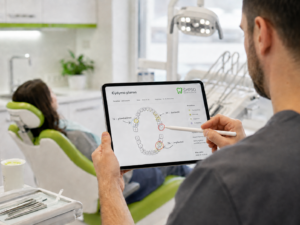
To make this possible, the Elpako biometric signature platform now includes a new drawing feature. It allows an image, photo or diagram to be added to a document template so that the customer can mark the required information directly on a tablet before signing the document.
When a document needs more than text
In many customer service processes, a document is more than just something that needs to be signed. Before signing, specific information often needs to be recorded, such as where a defect is located, which part of a service was discussed, which area is relevant to an agreement or what condition an object is in.
Until now, these situations often required additional attachments, handwritten notes, separate photos or verbal explanations. This makes the process more complicated because some of the information remains outside the document or needs to be linked to it manually later.
The drawing feature allows this information to be recorded exactly where it belongs: directly in the document.
How does the drawing feature work?
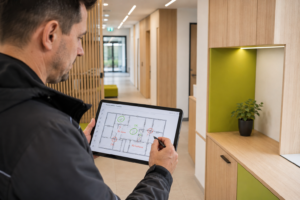
When creating a document template, the administrator can add a photo, diagram or another image and define an area where the customer will be able to draw or mark the required elements.
When completing the document on a tablet, the customer sees the image and can mark specific areas directly on it. This can be a simple line, circle, arrow or another visual mark. Once the document is completed, the customer signs it on the tablet using a biometric signature.
As a result, the document contains not only written information and a signature, but also clear visual information about the agreement or a specific fact.
Where can it be useful?
The drawing feature is useful whenever a document needs to show not only what the information is, but also the exact object, part, location or area it refers to.
In car rental, repair or insurance processes, scratches, dents and other damage can be marked directly on a photo or diagram of the vehicle. The same approach can be used in warranty service. Instead of describing where a screen is cracked, where the casing is damaged or which part of a product has a problem, the exact location can be marked directly in the document.
In construction and manufacturing, the feature can be used not only to record defects but also to provide more detail about an order. When ordering windows, doors, facade elements, furniture or other custom-made products, it can be used to indicate opening directions, mark the position of openings, show requested changes or even draw a simple sketch of the required solution. When working with building plans or technical drawings, users can also mark the exact location of a defect, planned work or another important area.
The same feature can be useful in agriculture and professional inspections, where a specific part of a field or land plot needs to be marked on a plan or diagram, for example an area of damaged crops. In event planning, the location of a stage, stand, registration area or another agreed zone can be marked directly on the event layout.
In medicine and healthcare, a specialist can mark the exact area related to a treatment or procedure. For example, a dentist can identify the teeth that require treatment, while a specialist in aesthetic medicine or beauty procedures can mark the areas where a procedure is planned.
Drawing can also be useful in property handover documents. When a home is rented or handed over, specific damage to walls, floors, furniture or other elements can be marked directly in the document, making it easier to record the condition of the property accurately.
All these examples have one thing in common: the document needs to show not only what, but also exactly where. Visual marking reduces the risk of different interpretations and makes it clearer what has been agreed before the document is signed.
A visual agreement before signing
The main value of this feature is not the drawing itself. The value comes from turning visually marked information into part of the document and confirming it when the document is signed.
This allows an organisation to record the discussed situation more precisely, while the customer can clearly see what they are confirming before signing. The document becomes more complete, clearer and more reliable.
In the Elpako biometric signature platform, the drawing feature is integrated into the existing document completion and signing process. The customer can fill in the required fields, mark information on an image and sign the document in one place, directly on the tablet, without paper or additional steps.
Less uncertainty, more accuracy
Digitising documents is not only about removing paper from the process. The real value comes when a digital process helps collect information more accurately, reduces the risk of errors and makes customer service faster.
The drawing feature is a practical addition that supports exactly this goal. It helps organisations not only collect a signature, but also clearly record visual information that matters to a specific decision, service or agreement.
It is another step towards a simpler, clearer and more accurate document signing process at customer service locations.
Virtual Printer – Elpako New Feature for Fast Document Signing
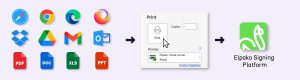
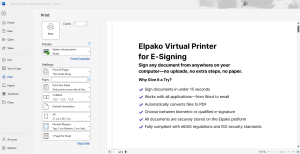
Signing documents directly from the print window isn’t new—but Elpako took a fresh approach and made it faster and even more intuitive. With the Virtual Printer, the process is as straightforward as:
Open → “Print” → Sign.
No pop-ups, no redundant steps—just a smooth, self-explanatory workflow. Fewer clicks. More efficiency.
Key Benefits
Simplicity
- Send your document directly to Elpako signing platform straight from the print window—no need to download, open your browser, or manually upload anything.
- The entire process takes less than 15 seconds.
Versatility
- Compatible with any application: Word, Excel, PDF, PowerPoint, JPG, PNG, browsers (Chrome, Edge, Firefox), documents from Google Drive, and emails from Outlook or Gmail.
- Automatically converts any file type into a PDF for signing.
Freedom of Choice
- Choose between a biometric or a qualified e-signature. You can sign the document yourself or invite someone else to sign.
- You see the document instantly and place your signature exactly where it needs to go—with a simple click or drag of your mouse.
Centralized Management
- All signed documents are securely stored on Elpako platform, with convenient tools for search, viewing, analysis, and exporting.
- You can track who has signed and easily resend the document for signing if needed.
Security
- All signatures meet eIDAS and ISO security standards, ensuring full legal validity.
- Because the document remains digital and never leaves the secure environment, risks like data leaks or printing errors are minimized.
When to Use the Virtual Printer vs. the Platform
The Virtual Printer is ideal when the document is already prepared and doesn’t require any additional information to be filled in—such as when an HR department sends a confidentiality agreement to a new employee for signature.
The platform is best suited for cases where the document needs to be both filled out and signed—for example, when a patient at a medical facility must provide details about their health condition and sign a consent form before a procedure.
How It Works – Step by Step
-
Install the Elpako Virtual Printer tool on your computer.
-
Open the print window in any program and select “Elpako Virtual Printer” from the printer list.
-
Log in to your Elpako biometric signing account (only needed the first time).
-
Choose your signature type: biometric or qualified e-signature.
-
Sign the document—it will be instantly saved on the Elpako platform.
Biometric vs. Qualified E-Signature – What’s the Difference?
Both signature types are legally valid, but they’re suited for different contexts—in-person or remote.
-
Biometric Signature
Best for in-person signing, such as at a customer service desk.
Signed using a tablet and digital pen, capturing unique traits like pressure, speed, and movement. -
Qualified E-Signature
Ideal for remote signing.
Uses Smart-ID, Mobile ID, or a national ID card. Legally equivalent to a handwritten signature.
Try It Today
The Virtual Printer is now available to all Elpako Biometric Signature users.
Try it out and experience a faster, simpler way to sign documents—right from your desktop.
When Business Moves Faster Than Its Paperwork
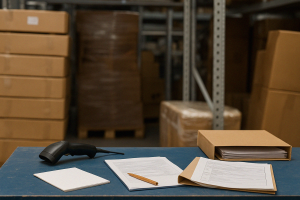
These scenarios are common—not because people don’t want to work efficiently, but because the tools they have can’t keep up. A mechanic inspects a vehicle with the client, yet still has to fill out paperwork at the front desk. Logistics specialists carry folders around the warehouse because they don’t have time to get back to a computer. Real estate agents return to the office just to send out documents via email. All these disruptions slow down workflows, increase the chance of errors, and ultimately hold businesses back.
What Does True Business Mobility Look Like?
Today, business must go where the customer is—mobile, agile, and fast. But true mobility requires more than a laptop or a smart device. It demands a shift in mindset: a continuous flow of information and decisions made in real time, on-site. Traditional document management—offices, paperwork, printers, disconnected systems—creates friction where there should be flow.
Digital mobility isn’t just about convenience. It represents a change in business culture: less formality, more trust between employee and customer; less waiting, more engagement. It fosters not only productivity but a better emotional work environment—where processes help rather than hinder. That’s exactly what Elpako Biometric Signature Platform enables: seamless, secure, and legally valid work—without interruption.
What Does Real Mobility Look Like?
Elpako solution is more than just an electronic signature. It’s a complete approach to document management—done through a single device, in one system, without extra steps:
-
Pre-built templates – no need to create documents on the spot.
-
On-site form completion and biometric signing – right where the job happens.
-
Instant document delivery – to clients or colleagues, with automatic syncing to your company’s document management system.
Four Real-World Scenarios from Everyday Business
Auto Repair Shop
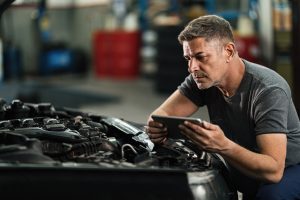
A mechanic discusses necessary repairs with the client on-site. The details are immediately recorded in a digital form, photos of the vehicle are attached, and everything is signed using a tablet with a biometric signature. The form is then emailed to the client. No extra paperwork, no administrative burden. The client gets full transparency and documented proof—saving time and avoiding any confusion.
Field Service Teams
A technician responds to a burst pipe at a client’s home. He records the work done, adds photos, signs the document on a tablet, and the form is instantly sent to both the client and the office. No printing, no phone calls. The client gets immediate confirmation, and the company gets an accurate record.
Equipment Rental
A technician delivers construction equipment to a job site. The handover form is completed on a tablet, equipment condition is recorded, photos attached, and both parties sign biometrically. The document goes straight to the office. All the information is stored where it’s needed and ready when it’s needed—essential when equipment moves between multiple sites daily.
Insurance Claims
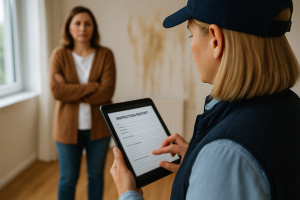
An insurance assessor visits a client’s home after an incident. They document the damage, complete necessary forms, add photos, sign the report on a tablet, and send it straight into the insurer’s system. The client doesn’t need to visit an office, and the claims process begins within minutes—easing stress and accelerating service.
Why This Matters for You
Maybe your company’s processes are technically “under control”—but how much time does it really take? Filling out paper documents on-site, transferring and sending them, making phone calls to confirm details—these steps cost work hours. Employees often revisit clients just to “finalize” a process, leaving customers uncertain about the outcome.
Smooth document management isn’t a bonus—it’s a foundation. When the system runs without friction, clients feel confident and employees feel in control. This isn’t just about saving time. It’s about peace of mind, speed, and respect for everyone’s time.
Businesses that adopt mobile signing solutions often see a 15–30% increase in services completed during a single visit. That means not only happier customers, but real financial results—fewer return visits, less wasted time, and more revenue per working hour.
If your team still waits to “handle documents” at a computer, it means one thing—you’re losing efficiency every single day.
Mobility Principles That Transform Customer Service
-
Speed: Less waiting, more doing.
-
Accuracy: Data is captured immediately—reducing the risk of forgetting or mixing things up later.
-
Trust: Clients are involved in the process and understand every step.
-
Efficiency: One visit = task completed.

Mobility isn’t the future—it’s the present, and the fast are already winning.
While some are still figuring out schedules and paperwork logistics, others are completing entire workflows on the spot, in just minutes. Some wait—others act. Every delayed step is a lost opportunity to deliver at the right time.
Digitization isn’t just a tech upgrade. It’s a way to free up time, reduce stress, and let your team focus on what they do best—serving clients, not managing paperwork. When documentation becomes invisible, business becomes faster, clearer, and more pleasant for everyone involved.
The less someone feels like they’re “handling documents,” the more efficient your organization becomes. Not because documents aren’t important—but because they no longer get in the way. When information flows seamlessly, your business moves decisively and quickly.
Start working faster, simpler, and smarter—with the Elpako Biometric Signature Platform.
To learn more, contact Business Development Manager Rokas Jašinskas at +370 620 54 160 or email [email protected].